
MACHINED GUIDE RAILS
By grasping market trends, we become leaders in providing elevator components with superior quality.
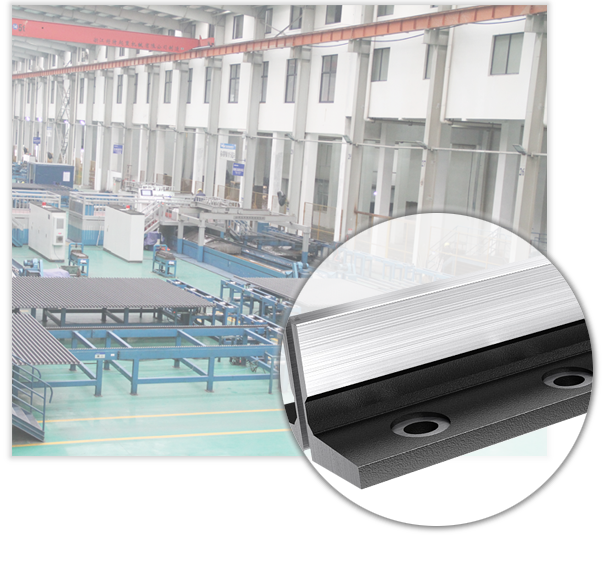
Surface roughness
The roughness of the guide surface directly affects the smooth operation of the guide shoes on the guide rail and also affects the storage of lubricating oil in the guide rail, thus affecting car operation and passenger comfort. It also affects the braking distance of the safety brake.
The roughness of the tenon and groove and the roughness of the mounting surface of the connecting plate affect the assembly accuracy of the guide rail, thereby affecting the stability and comfort of elevator operation.
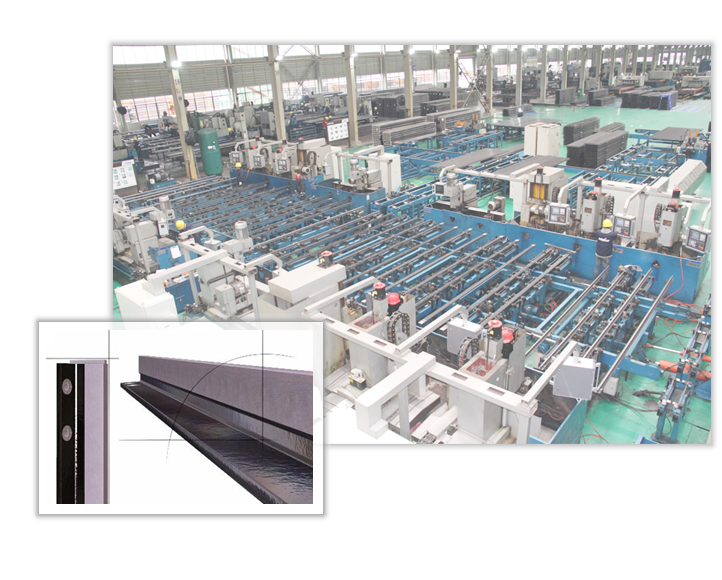
Verticality
End face perpendicularity refers to the perpendicularity between the guide rail end face and the machined surface to the bottom surface. The national standard requires ≤0.1mm.
Perpendicularity affects the guide rail connection accuracy, thus impacting the elevator’s operational stability and comfort.
Parallelism
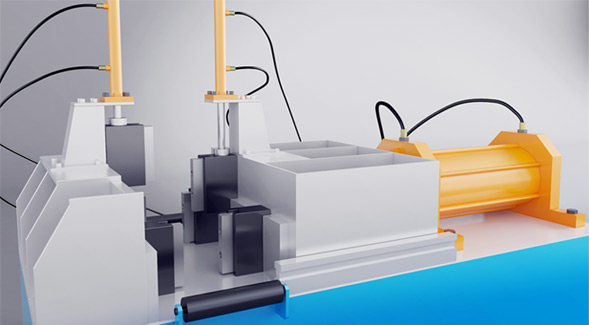
The parallelism between the bottom machining surface of the guide rail and the top surface of the guide surface must be ≤0.2mm according to national standards.
Parallelism affects the connection accuracy of the guide rail, thus impacting the stability and comfort of elevator operation.
Symmetry
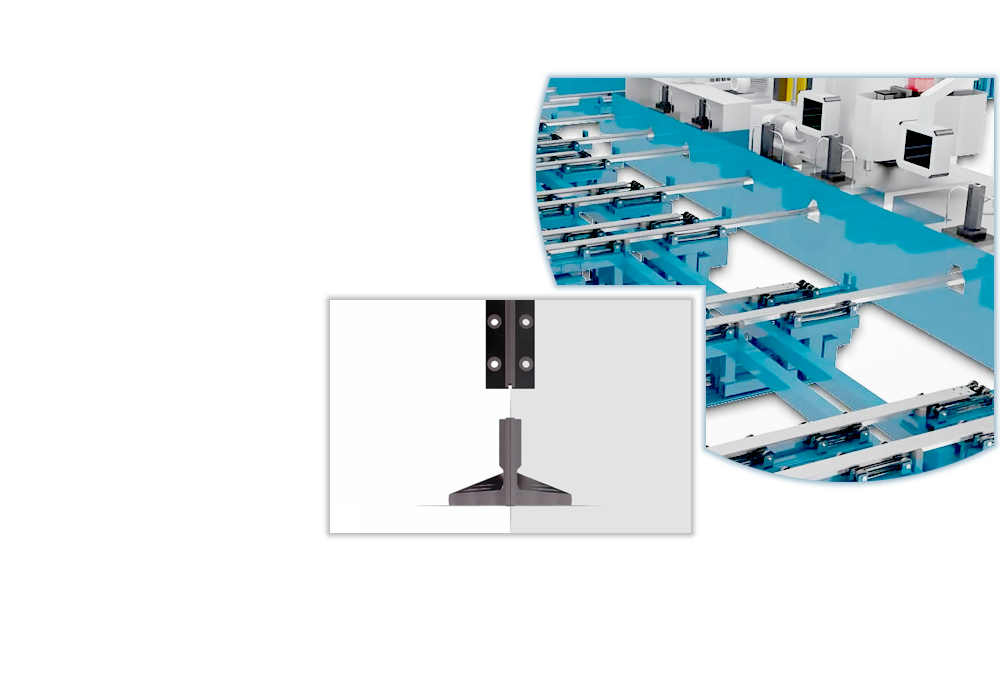
This mainly refers to the symmetry of the male and female tenons. The national standard requires a symmetry of ≤0.1mm, while high-precision guide rails require ≤0.05mm or even ≤0.03mm.
Symmetry has a significant impact on the connection accuracy of guide rails. Two guide rails with poor symmetry will create a step when connected, greatly affecting the smooth operation of the guide shoes, thus impacting the stability and comfort of the elevator.
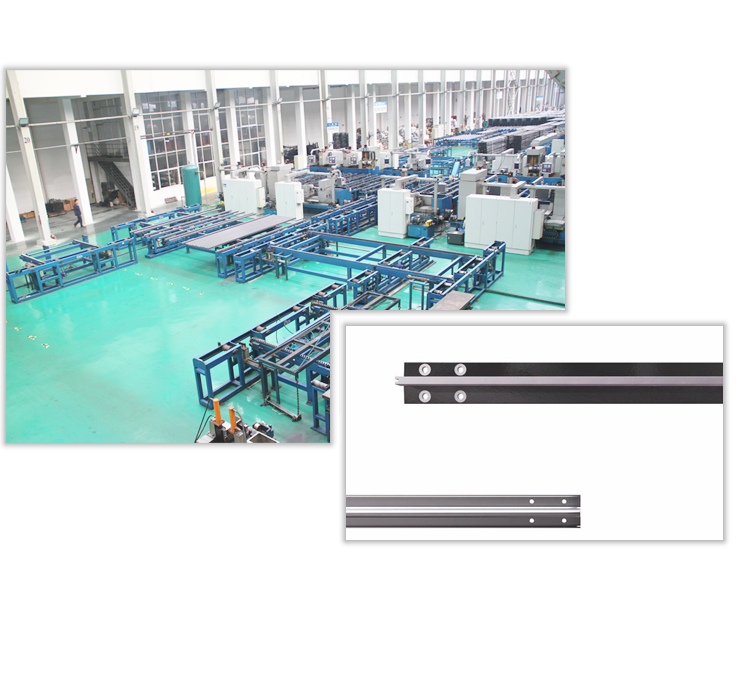
Tensile strength
The national standard requires a tensile strength of 410MPa-520MPa for the guide rail, a crucial mechanical property.
The tensile strength of the guide rail ensures sufficient support force when the safety clamp engages.
Symmetry
This mainly refers to the symmetry of the male and female tenons. The national standard requires a symmetry of ≤0.1mm, while high-precision guide rails require ≤0.05mm or even ≤0.03mm.
Symmetry has a significant impact on the connection accuracy of guide rails. Two guide rails with poor symmetry will create a step when connected, greatly affecting the smooth operation of the guide shoes, thus impacting the stability and comfort of the elevator.

Chemical composition of raw materials
Carbon (C): 0.14%–0.22%; Silicon (Si): 0.13%–0.35%; Manganese (Mn): 0.35%–0.65%; Phosphorus (P) ≤0.045%; Sulfur (S) ≤0.045%.
Increasing the carbon content in steel raises the yield point and tensile strength, but reduces plasticity and impact resistance.
Silicon acts as a reducing agent and deoxidizer; manganese acts as a deoxidizer and desulfurizer, and can improve the toughness and strength of steel. Phosphorus and sulfur are harmful elements in steel, reducing its ductility and toughness; their content must be less than 0.045%. The hardness of the guide rail ensures sufficient friction when the safety clamp brakes.
Straightness and Twist
Straightness refers to the offset of the guide rail surface in the straight direction, and can be divided into top surface straightness and side surface straightness. Top surface straightness refers to the offset of the top surface of the guide rail in the straight direction, while side surface straightness refers to the offset of the side surface in the straight direction.
Bending points on the guide rail exert a reaction force on the guide shoes, causing car swaying. As the elevator speed increases, the car will become unstable and even vibrate, affecting passenger comfort.
The national standard requires that within a length ‘a’, B/A ≤ 0.001 (a not less than 1m), where ‘a’ refers to the minimum measurement length, B refers to the maximum distance of the measurement point offset from the reference plane, and A refers to the shortest distance from the measurement point with the largest offset to the reference point. High-precision guide rails used in high-speed elevators have even higher requirements, requiring a length of 5m to not exceed 1mm.
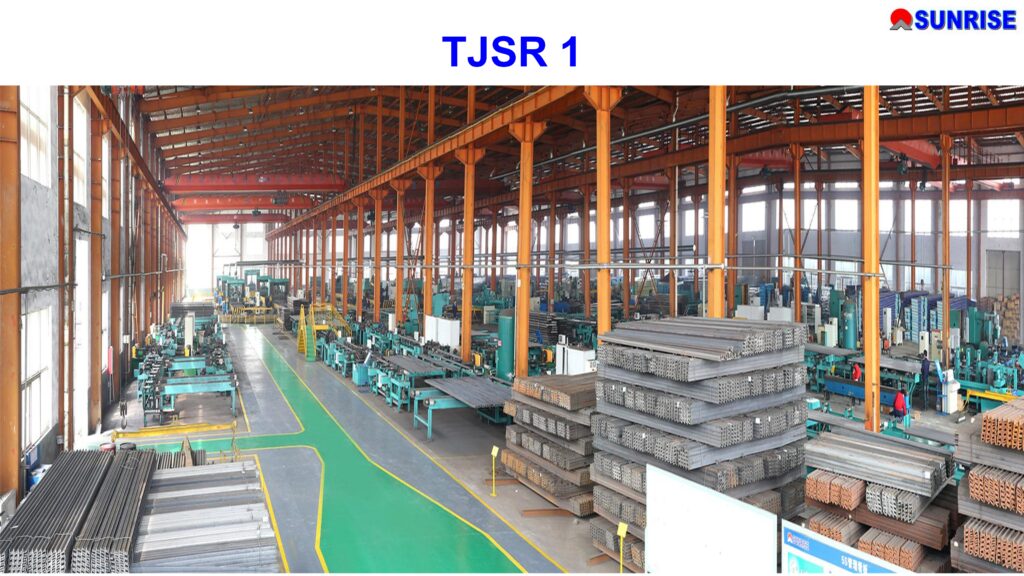
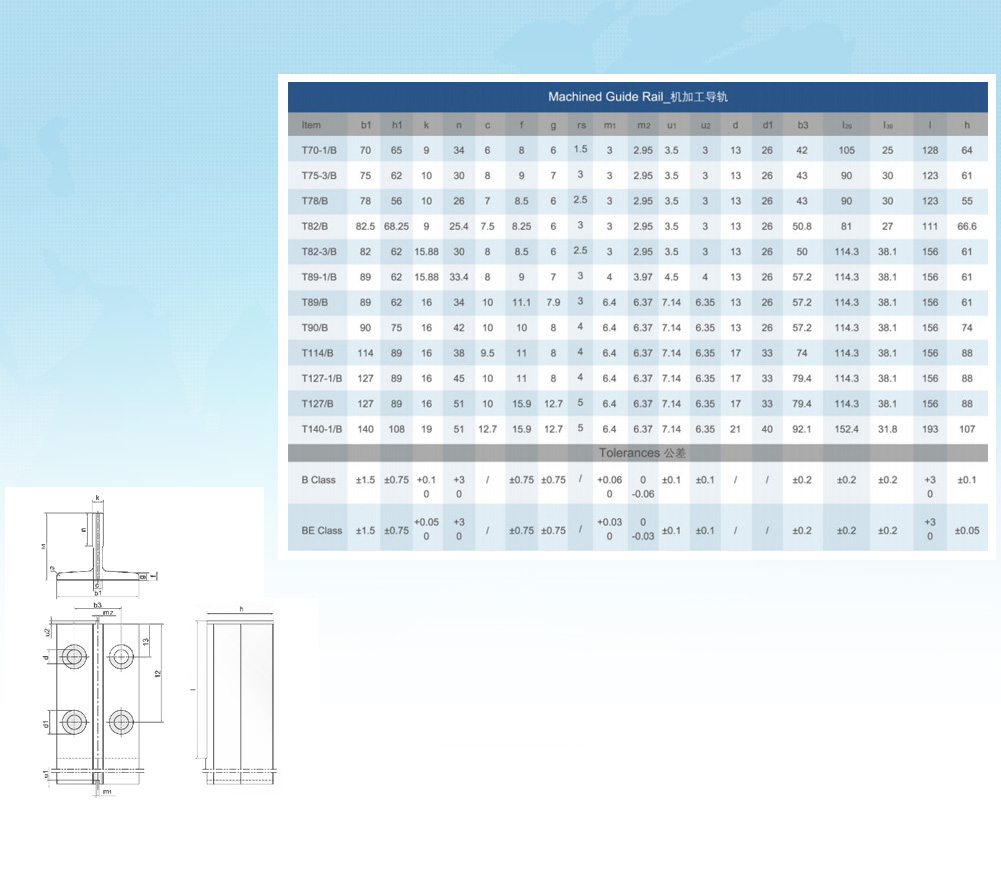
Guide rail model
Guide rail naming follows national standards. A solid rail includes three elements: T-shaped rail, base plate width, and manufacturing process. /A indicates cold drawing, /B indicates machining, and /BE indicates high-precision machining. When necessary, numbers are used to indicate guide rails with the same base plate width but different cross-sections. Examples: T45/A, T50/A, T70-1/B, T89/B, T90/B, T114/B, T127-1/B, T127-2/B, T140-1/B, T140-2/B, T140-3/B.